Inlägg

Visar inlägg med etiketten Linux

Software updates and versioning
Bild
When publishing software, it is custom to update software version when releasing an update. Why would you just silently replace a released software package with an updated one without changing version? In most cases this means that users downloading the package for the first time will get the latest package, but users that have downloaded the software previously will receive no notification about an update (assuming that there is an upgrade mechanism such as apt, yum or dnf, or in the Windows world maybe a custom software updater). If the update isn't worth pushing out to all users, why not just wait with pushing out the change until next official release? I don't know, but it feels like hiding something. Or maybe the publisher is just clueless. The only thing I could think of that would justify doing this, is if the software installation package has some minor issue (or completely broken thus preventing any installation). But not updating version numbers is just, well... weird...

RuneScape NXT client for Fedora

RuneScape is a massively multiplayer online role-playing game ( MMORPG ) created by Jagex Ltd.. Their Linux client allows you to play the game natively also in Ubuntu. The client is written in C++ and uses OpenGL rendering. For reference, the Ubuntu client is available here: https://www.runescape.com/download . It is possible to play also in other Linux distributions, if you use the same libraries as in Ubuntu. This Fedora rpm is created from the Ubuntu package with two extra libraries that are privately installed. They don't interfere with the rest of the system. I don't guarantee that the client will work in the future, but as of now it works fine. There is a 64-bit package available for Fedora 25 and 26. Because the RuneScape client is proprietary, it isn't possible to host the package in the usual package repositories. For now it is provided here from my own private repository. To enable this RuneScape repository in Fedora: sudo dnf -y config-manager --add...

Steelseries Arctis 7 headset in Linux

Bild
UPDATE. This headset works without modifications in Linux after the changes were committed to pulseaudio in 2017.  The Steelseries Arctis series headsets are very comfortable. You can wear this headset all day long thanks to the comfortable head strap. Steelseries Arctis 7 There are three models, Arctis 3, 5 and 7. The last one is the most expensive and has wireless connection. Arctis 5 is basically the same without wireless (only USB connection). Arctis 3 has only analog inputs. I've got the Arctis 7 model and of course I'm using it with Linux. There were some issues setting it up. It works fine in Alsa, the device is recognized. You do have to adjust sound levels, at least the mic has too low sound level. Use alsamixer on command line to adjust all volume levels for the headset to 100% (the two outputs and one input). But Pulseaudio has some issues. Only the mono device (chat output) and microphone is visible. This is because the headset uses a non-supported co...

E-books in Linux with Adobe Digital Editions

Bild
I've read a lot of e-books . And since I use Linux devices, it is sometimes a bit problematic. How do you read e-books that you have bought in Linux? One way is to read public domain and free e-books. There are a lot, just search for them on the Internet. But they are mostly old books. Some writers actually publish some of their books explicitly without DRM. I like those writers. Then it is easy to transfer the book to any of your devices. There are many e-book readers on linux. I like Calibre and Fbreader . Calibre for managing and converting ebooks and also reading on the PC, and fbreader for reading on smaller devices, like my linux phone and tablet. The DRM-equipped e-books that I have bought are all the Adobe DRM type that have to be read in Linux using Adobe Digital Edition (ADE) using wine . So far the old 1.7 ADE version has been sufficient. The good thing with that version is that it just works. No runtime installation in wine or nothing, just install and fire it u...

Steam Family sharing working on Linux again

For a long time, at least a year, Steam Family sharing has been broken on Linux PCs. Fortunately something has changed and it is suddenly working again (as of January 2017). I'm a bit disappointed at Valve's support, though. The problem hasn't been commented on at all by Valve, even though it has been reported both in the Steam support forum and on github: https://github.com/ValveSoftware/steam-for-linux/issues/4051 At least the problem could have been acknowledged.

NBASE-T or IEEE 802.3bz - faster speeds for your network

There have been efforts a few years ago in bringing 10 Gbit/s network speeds to PC motherboards. It has also been used in servers, but mostly using fiber cable. It is only recently when the standard has evolved to be usable with regular twisted pair copper cable. With CAT6a cable you could in theory reach 100 m using 10GBASE-T. Due to the high requirements of 10 Gbit ethernet, it is often not possible to communicate over longer links due to not spec compliant cable, or when using much more common CAT5e cable. What happens then is that the network link speed is lowered from 10 Gbit/s to 1 GBit/s. Recently a new standard has been evolving to lower the implications of this problem. New speeds of 5 Gbit/s and 2.5 Gbit/s have been introduced in a new standard IEEE 802.3bz and then later in practice as the NBASE-T alliance. With IEEE 802.3bz, a speed of 5 GBit/s can be used with up to 100 m CAT5e copper cable. What this means is that when your 10 Gbit/s link doesn't manage to k...

Razer Deathadder on Linux

Bild
I've got a Razer Deathadder mouse connected to one of my PCs. This is a quite popular gaming mouse. It doesn't work fine in a standard Linux distro (at least on Fedora). The resolution is too high and it isn't possible to turn down. In the past I used a script and xinput to lower the mouse sensitivity . But there is a driver for Linux created by the free software community, in this case by Michael Büsch . The driver automatically sets the resolution to something usable and you can set different profiles and tune it from the command line or using a GUI application (the latter which doesn't currently work on Fedora due to missing python libraries, but no big deal). I've been using this driver for a long time, first by compiling it from source, and later through the rpmsphere-release repostory at https://build.opensuse.org/project/show/home:zhonghuaren . At one point it stopped working and I found out that it hadn't been updated in a few months in t...

Two-factor authentication with TOTP applications

Bild
Many websites and online services offer two-factor authentication (2FA) using SMS or using a Time-based One-Time Password (TOTP) application (some services also offer an email link, but I will not cover it here, although it also adds security in a similar way). It is highly recommended to use two-factor authentication to sign in to websites. It adds one layer of information besides the password, which makes signing in to online websites a bit more secure. The only way someone can get into your account is if they acquire both your password and the secret key on your phone. I prefer TOTP over SMS, because SMS is sometimes more unreliable and slower. (I won't discuss which method is more secure; there are potential vulnerabilities in both use cases depending on device and platform) Time-based One-Time Password A Time-based One-Time Password algorithm calculates a one-time password from a shared secret key and the current time. It is a standard described in RFC 6238 . It re...

Firefox Tracking Protection for all users

Bild
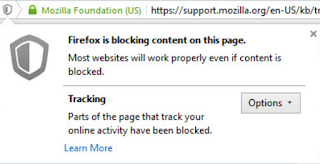
Firefox Tracking protection is a great feature used in Private browsing mode. But turning on Firefox tracking protection permanently has several benefits. According to researchers it makes pages load 44% faster and reduces data usage by 39%. You will also get rid of most personalized advertisement, thus the increased performance. Personally, I prefer to choose my advertisement myself. You can turn on the feature in Firefox by typing about:config in the location bar and hitting enter. Type and find privacy.trackingprotection.enabled and double-click it to toggle it to true. But how to turn this feature on for all users on the same PC ? Usually family members are not tech-savvy enough to mess around in the Firefox configuration interface. Behold, if you are an administrator, you can set a machine-wide setting. You can tell Firefox to read system preferences by creating a file defaults/pref/local-settings.js in the Firefox installation directory. Then set the default preferenc...

SleepyHead in Fedora Copr

Fedora Copr is an automated build system with a repository as output. You upload the source, select desired build systems (Fedora, Redhat) and get one or more rpm packages in repositories automatically. There is now a Fedora 24 Copr repository for SleepyHead: https://copr.fedorainfracloud.org/coprs/johanh/sleepyhead/ This means you can install SleepyHead from command line with: sudo dnf copr enable johanh/sleepyhead sudo dnf install sleepyhead As long as the repository is enabled, you will also receive any updates to SleepyHead when updating your system with dnf update.

SleepyHead Fedora rpm package

Bild
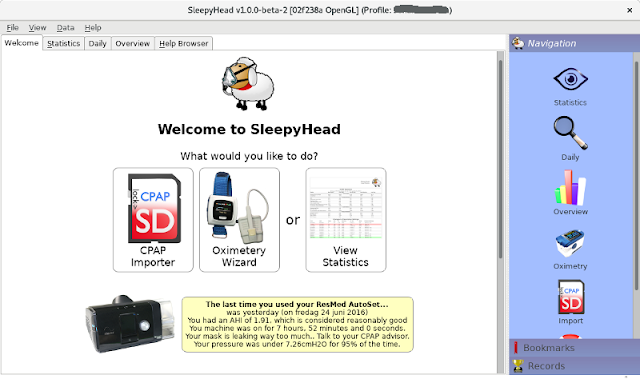
Sleep apnea It is not so bad getting a diagnosis for sleep apnea. Some people are not even aware of their condition. But it is important to get help, because your health could suffer. Some people might feel a little tired, but other could develop serious illnesses. For more information, see https://en.wikipedia.org/wiki/Sleep_apnea . CPAP units So I got this CPAP unit (almost for free because of our Nordic national health insurance). It is locked down, so I can't get any useful data directly out of it. But there is an SD card that is meant to be analyzed by my doctor. And there are free software on the Internet. SleepyHead Meet SleepyHead: http://sleepyhead.jedimark.net This is a very nice and free (GPL3) cross-platform program. Works in Windows, Mac and Linux. It is able to import data from an SD card of the most common CPAP units. There is also support for a few pulse oximeters. Below is a screenshot of the welcome screen. It is important to note that you...

Enabling Hibernation in Fedora 23

By default, Fedora doesn't enable hibernation (suspend to disk). Basically what you need is a big enough swap partition. Then it has to be added to fstab and Grub. Initramfs also has to support resuming from hibernation. On my laptop (MSI GE60) unfortunately the swap partition was too small. Fedora recommends that a swap partition should be half the size of RAM without hibernation and 1.5 the size of RAM with hibernation with 8 GB - 64 GB of RAM [1] . This laptop has 12 GB of RAM, but only a 6 GB swap partition. The partition has to be extended to 18 GB. There is a 250 GB SSD with 174 GB of space in /home (ext4 on LVM). I had to reduce the home partition to 162 GB to free up space for the swap partition. Of course, I had to free up enough space in the filesystem first. It is better to have a few times more free space than the amount to be reduced. Resizing an LVM/ext4 /home partition I don't recommend doing this, unless you have knowledge about partitions and LVM. Yo...

Using Dropbox from command line in Fedora

Dropbox is a file hosting service operated by Dropbox Inc. that offers easy cloud storage on multiple platforms. Note that Dropbox is proprietary software, but offers a free account with up to 2 GB of storage [1] . Personally I've used Dropbox to sync files between PCs and also phones. In Fedora linux, you can install Dropbox from the RPM Fusion repository [2] . This is basically an installer and command line client script for the binary Dropbox daemon (application) that then has to be separately installed by each user. There is also a plugin for nautilus, the file manager: nautilus-dropbox. To install, simply issue on the command line as root (or sudo): dnf install dropbox nautilus-dropbox You could also download the program from Dropbox home page and install it manually [3] . I prefer using the Fedora package, then it will be nicely integrated also in Gnome on a desktop PC. The following instruction is how to install and configure on a headless PC, using only the comm...

Easy Minecraft installation in Linux

This is an installation script for Minecraft on Linux. It installs the Minecraft launcher in the system, so that all users can easily start and play Minecraft. It creates icons and a shortcut to the launcher. The script is an improved version of this script (github https://gist.github.com/wvega/728367 ) When the user starts Minecraft, it will download a copy of Minecraft to the user's home directory, exactly like when manually installing Minecraft. This script works fine on Fedora, but I imagine it should work on most Linux distros. The only requirement is that Java is installed somewhere. The script assumes there is a link to Java at /usr/java/latest/bin/java or in /usr/bin/java, otherwise it will exit with an error. The script downloads the Minecraft launcher, and installs it system wide. Sometimes the Minecraft launcher address has changed and then of course the script must be updated. Download the shell script here or from github . Do "chmod +x minecraft-insta...

Identifying an unknown Windows hard disk - reading Windows file versions in Linux

What do you do when you have an unkown Windows hard disk or partition, that you don't want to boot or that is unbootable? How do you identify the Windows version installed on the hard disk or partition? In Linux, we are used to mount the hard disk and then look at /etc/issue, /etc/redhat-release or something similar. You can even see the kernel version in the file names of the installed kernel images in /boot. But for a Windows OS? Well, you could look at the version of ntoskrnl.exe, for instance. Here are the version numbers for different versions of Windows [1]: 4.x: NT 4.x 5.0: Windows 2000 5.1: Windows XP 5.2: Windows 2003 Server (and R2), Windows XP 64-bit 6.0: Windows Vista, Server 2008 6.1: Windows 7, Server 2008 R2 6.2: Windows 8, Server 2012 6.3: Windows 8.1, Server 2012 R2 10.0: Windows 10, Server 10  So just mount the hard disk/partition and then look for C:\Windows\System32\ntoskrnl.exe. But how do you read the version number of a Portable Executable (PE) f...

Laptop touchpad stops working after suspend

The MSI GE60 Laptop has an Elantech touchpad that has always had some problems working in Linux after suspending and resuming the laptop. Edit: Found some notes. It seems to have worked fine in Fedora 18, but in Fedora 19 after a synaptics driver update (xorg-x11-drv-synaptics-1.7.1-3.fc19.x86_64) it went totally nuts. Edge scrolling stopped working and after suspend/resume, the touchpad notification icon was flashing over the GDM login prompt, alternating with the on and off icon image. The touchpad was also turned off after reboot and couldn't be turned on except for in the Gnome system settings. After a few updates, some of the problems were fixed, except for the problem that it is turned off after suspend/resume. At least now with Fedora 20, which is currently installed on the laptop, the touchpad always stops working when resuming from suspend, and the hardware button to turn on doesn't affect its state. It is using the psmouse kernel driver and synaptics in Xorg: ...

Commercial software on Linux - RAR

I found that I had an old registration key for WinRAR laying around. Since I don't use Windows any more at home, I checked and found that there is indeed a commercial Linux version of the software available nowadays. RAR is a proprietary archive format that was widely used in the 90's and the next decade when the Internet became a popular place to share software and media files. It has better compression ratio than ZIP, has strong encryption and very good error recovery capabilities. I have some memories from my time as a student of keeping a WinRAR binary on a floppy and use it to decompress and compress files transferred from and to the Internet. I'm not going to debate over FOSS vs. commercial software in this post. If we weigh in such arguments, there are no reasons to use anything else than the LGPL licensed 7Z (p7zip) or tar with bzip2, gzip or xz (and their parallel variants), but that was not the point of this post. There is also a freeware unrar program and l...

Preventing normal users from Shutting Down or Rebooting PC

The default policy in linux is often that normal users can shut down or reboot a PC, even if other people are logged in. When using a desktop PC as a server or if you often leave your applications open, you don't want that to happen. This is a question that comes up many times on the Internet. The problem is that the components in linux change and not every distribution uses the same components. In linux, only root has the power to shut down or reboot. Many linux distributions use Policykit for rules to override this and let the normal users shut down and reboot. In Fedora 21, to override the default rules, create a new rule with the following command: sudo nano /etc/polkit-1/rules.d/60-noreboot_norestart.rules  Paste the following text: polkit.addRule(function(action, subject) {     if (action.id == "org.freedesktop.login1.reboot" ||         action.id == "org.freedesktop.login1.reboot-multiple-sessions" ||   ...

Hard disk Firmware update on the Linux command line

Sometimes you will find that your hard disk is slow, or there are some other issues with disk performance. If you are lucky, the disk is not broken. It could have some firmware bugs, and if you are even more lucky, the manufacturer could have issued a firmware update. I've updated several hard disk firmwares in the past. Usually you have to use a boot disk with DOS or something to update the firmware. Why updating firmware? One of my hard disks in the past needed a new firmware because it was dropping out from a RAID controller. It began working fine after the firmware update. The latest hard disk that needed firmware update was Seagate 15k.7 ST3450857SS SAS. I noticed that the disks sometimes slowed down during writes and even stalled. I use two 450GB disks in software RAID 1. By googling I found that there were other people having similar problems with the same disk and that there were actually a firmware update available from Seagate. Also Dell, HP and IBM seems to ha...

Using IBM ServeRAID M1015 card in Linux

Bild
The FusionMPT SAS2 based cards by LSI are cheap RAID cards that perform well in RAID 0 and 1 under Linux with SSDs and ZFS arrays. They are used in many 1U servers with one or two disks. They are also a popular SAS 6.0 / SATA III controllers for enthusiasts. You can get them cheap on ebay. Before SATA III was common on motherboards, this was THE card to get. It can still be useful if you need SAS disks or additional disks or have a need for disk enclosures. It is identical to the LSI MegaRAID SAS 9220-8i. The same hardware is also used in LSI 9240 and LSI 9211. It is possible to use the BIOS from another card (crossflashing) to change the features of the card. There are a few different BIOS files you can use. Specifications:  Official LSI information 8-lane, 5 GT/s PCI Express 2.0 Identical to LSI 9240-8i card 6 Gb/s per port Two x4 internal SFF-8087 connectors Controller LSISAS2008 Low cost SATA+SAS RAID solution RAID levels 0, 1, 5, 10, 50 and JBOD mode >...